Table of Contents
ToggleBuilding a home theater isn’t just about the screen and speakers. The door is one of the most overlooked components, and one of the most critical for controlling sound. A standard hollow-core interior door does almost nothing to contain low-frequency bass or prevent dialogue from bleeding into the hallway. Meanwhile, sound leaking in from the kitchen or laundry room can wreck immersion during a quiet scene. Whether someone is retrofitting an existing space or framing a dedicated theater room, the right door can dramatically improve audio quality and keep the peace with the rest of the household.
Key Takeaways
- A specialized home theater door with a Sound Transmission Class (STC) rating of 45+ is far more effective than standard hollow-core doors (STC 20–25) at blocking sound transmission and preventing audio from disturbing other rooms.
- Solid-core doors ($150–$400) provide a budget-friendly upgrade that handles mid- and high-frequency sounds, while acoustic-rated doors ($500–$1,500+) offer superior low-frequency isolation through multiple layers of dense material and integrated automatic drop seals.
- Perimeter seals and thresholds are critical—even a ⅛-inch gap can reduce STC effectiveness by 5–10 points, making compression gaskets, magnetic seals, and automatic drop seals essential features of any home theater door.
- Proper installation requires precise measurements, three to four ball-bearing hinges to support extra weight (100+ pounds for acoustic models), and careful seal alignment to maintain acoustic performance over time.
- A home theater door upgrade is one of the most cost-effective soundproofing measures per dollar, often delivering greater impact than acoustic panels, and works best when combined with wall treatments, HVAC modifications, and thorough sealing of penetrations.
Why Your Home Theater Needs a Specialized Door
Standard builder-grade interior doors, typically hollow-core with a thickness of 1⅜ inches, offer minimal sound resistance. They’re lightweight, inexpensive, and designed to provide privacy, not acoustic isolation. Sound, especially low-frequency rumble from action sequences or subwoofers, passes right through them.
A specialized home theater door addresses two challenges: sound transmission (keeping theater audio from disturbing other rooms) and sound intrusion (blocking exterior noise from entering the theater). The Sound Transmission Class (STC) rating measures how well a door blocks sound. A hollow-core door typically rates around STC 20–25, which is roughly equivalent to normal speech being clearly audible through the door. A solid-core door improves that to STC 30–35, and purpose-built acoustic doors can reach STC 45–55 or higher.
Beyond raw performance, a dedicated theater door also handles the physical demands of repeated use. Home theaters often see more traffic than a typical bedroom, and a well-built door with quality weatherstripping and seals will maintain its acoustic performance over time. Upgrading the door is one of the most cost-effective soundproofing measures, often more impactful per dollar than adding acoustic panels or bass traps.
Types of Home Theater Doors to Consider
Solid Core Doors
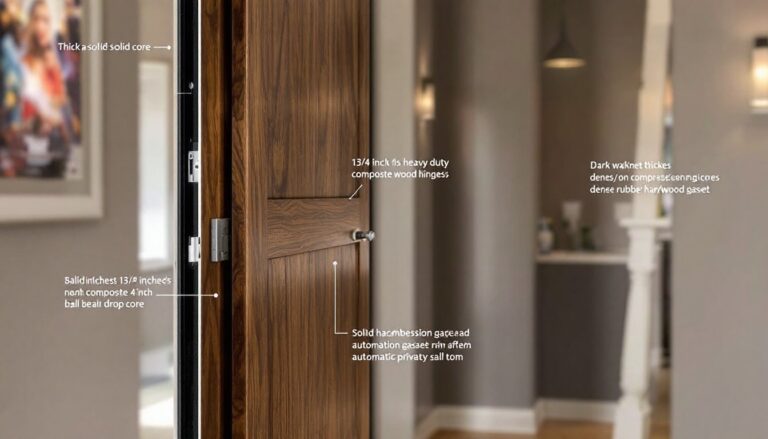
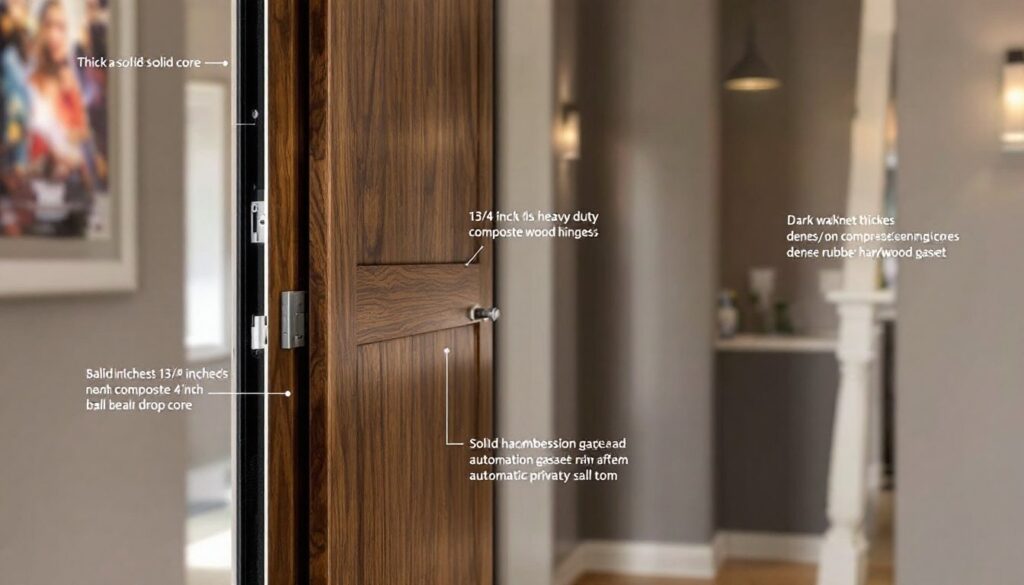
Solid-core doors are the baseline upgrade for any home theater. Unlike hollow-core doors, they’re constructed with a dense composite wood core or particleboard, wrapped in veneer or molded hardboard. Standard thickness is 1¾ inches, and they weigh 60–90 pounds depending on size.
They’re widely available at home centers, typically priced between $150–$400 for a pre-hung unit (door, jamb, and hinges). Installation is straightforward, if someone has hung a door before, a solid-core unit installs the same way, though the extra weight requires three hinges instead of two. They’ll need a helper to manage the weight during fitting.
Solid-core doors provide a noticeable improvement over hollow-core, especially for mid- and high-frequency sounds (dialogue, gunfire, music). But, they’re less effective against low-frequency bass, which requires additional mass or decoupling strategies. For a budget-conscious build, a solid-core door paired with quality weatherstripping and a door sweep delivers solid performance without specialized ordering.
Acoustic-Rated Doors
Acoustic-rated doors (also called soundproof or studio doors) are purpose-engineered for maximum sound isolation. They feature multiple layers of dense material, often MDF or mass-loaded vinyl (MLV), sandwiched together, with some models incorporating air gaps or damping compounds. Thickness ranges from 1¾ to 3 inches, and weight can exceed 150 pounds.
These doors often include integrated seals: magnetic or compression gaskets around the perimeter and automatic drop seals at the bottom threshold. When the door closes, the drop seal deploys to eliminate the gap between the door and floor, a common weak point for sound leakage.
Acoustic doors are available from specialty suppliers and run $500–$1,500 or more, depending on STC rating and finish. Installation is more involved. The extra weight may require continuous (piano) hinges or reinforced jamb anchoring, and the threshold often needs modification to accommodate the drop seal mechanism. Many manufacturers provide installation templates and hardware kits, but this is a project where precision matters, poor fitting undermines the acoustic performance. If someone hasn’t installed a door before, it’s worth consulting building a dedicated home theater for layout planning, especially if the door is part of a larger soundproofing strategy.
Key Features That Make a Great Home Theater Door
Mass and Density: Sound isolation scales with mass. Heavier doors block more sound. Look for doors with a minimum weight of 60 pounds for solid-core, 100+ pounds for acoustic models. If comparing options, ask for the door’s pounds per square foot, a useful metric when evaluating performance.
Perimeter Seals: Gaps are the enemy. Even a ⅛-inch gap around the door perimeter can reduce the effective STC rating by 5–10 points. Quality doors include compression gaskets (foam or silicone strips that compress when the door closes) or magnetic seals (similar to refrigerator gaskets). These should run the full perimeter: both jambs, the head, and the threshold.
Threshold and Door Sweep: The gap under the door is typically the largest air leak. An automatic drop seal (also called a door shoe or guillotine seal) extends when the door closes, sealing the gap. Manual sweeps, brush, rubber, or silicone, are a budget alternative but less effective and prone to wear. The threshold itself should be solid, not a hollow aluminum saddle.
Hinge and Latch Quality: Heavier doors demand robust hardware. Use three 4-inch ball-bearing hinges minimum: acoustic doors may need four or continuous hinges. The latch should engage firmly with minimal play. A privacy latch (the standard twist-lock on bedroom doors) works fine, but some theater builders prefer a passage latch (no lock) to avoid accidental lockouts during movie nights.
Finish and Aesthetics: Most solid-core and acoustic doors come unfinished, primed, or with a basic veneer. They accept paint, stain, or veneer matching. Some builders add upholstered panels (fabric over foam) to the theater-facing side for additional damping and a custom look. Just ensure any added materials don’t interfere with the door seals.
DIY Installation Tips for Your Home Theater Door
Check the Rough Opening: Standard interior doors fit a 32-inch or 36-inch nominal width rough opening (actual opening is slightly larger). Measure the existing opening height, width, and depth. If replacing an existing door, the new unit should match these dimensions. For new construction, frame the rough opening 2 inches wider and 2½ inches taller than the door slab to allow for the jamb and shims.
Prep the Jamb and Shims: Most pre-hung doors include the jamb, but acoustic doors sometimes ship as slab-only. If building a jamb, use ¾-inch or thicker stock to support the weight. Set the door in the opening and use cedar shims behind each hinge location and at 12-inch intervals along the jamb. Check for plumb with a 4-foot level, critical for proper seal engagement and smooth operation.
Install Hinges First: Attach the hinges to the door slab (if not pre-installed), then hang the door on the jamb. With heavy doors, use a door jack or shim stack to support the weight while driving screws. Replace at least one screw per hinge with a 3-inch screw driven into the wall stud for solid anchoring.
Seal Installation: Apply perimeter seals after the door is hung and operating smoothly. Clean the jamb surfaces with isopropyl alcohol, then press the adhesive-backed gaskets into place. For drop seals, follow the manufacturer’s template, most mount to the door bottom with screws and require precise height adjustment so the seal engages the threshold without dragging.
Test and Adjust: Close the door and check for even compression of the perimeter seals. Light shouldn’t be visible around the edges. Adjust the strike plate if the latch doesn’t engage cleanly. If the door binds, plane or sand the edges in small increments, removing too much compromises the seal.
Safety Note: Heavy doors can cause finger injuries during installation. Wear work gloves and use proper lifting technique. If the door exceeds 100 pounds, a second person is non-negotiable.
Soundproofing Enhancements Beyond the Door
Even the best door won’t deliver full isolation if the walls are weak. Standard ½-inch drywall on 2×4 studs offers roughly STC 33. Adding a second layer of drywall with Green Glue damping compound between layers boosts performance to STC 45–50. For serious builds, consider staggered-stud or double-wall framing with fiberglass batt insulation in the cavities.
HVAC and ductwork are common sound flanking paths. If the theater shares ductwork with adjacent rooms, sound travels freely through the ducts. Install duct silencers or flexible duct runs with baffles. For new construction, dedicated HVAC zones with proper damping reduce crosstalk.
Ceiling and floor assemblies also matter. Sound travels through floor joists and ceiling cavities. Adding resilient channels or isolation clips when hanging ceiling drywall decouples the structure and reduces vibration transmission. For floors, an underlayment pad (rubber or cork) under carpeting damps footfall noise.
Don’t overlook electrical boxes and wall penetrations. Recessed switches and outlets create air gaps. Use acoustic sealant (a non-hardening caulk) around boxes and seal any holes for wiring. Switch to airtight electrical boxes for new installations.
Finally, test the room. Play a bass-heavy scene at reference volume and walk the perimeter. Listen for leaks at corners, the ceiling/wall junction, and around the door. Small gaps can often be sealed with acoustic caulk or additional weatherstripping. These details, combined with proper soundproofing techniques, ensure the theater performs as designed, and thoughtful design choices support both acoustics and aesthetics.