Table of Contents
ToggleHarman Kardon has been delivering high-end audio since 1953, and their home theater systems continue that legacy. Whether someone’s upgrading from a TV’s tinny speakers or replacing an aging surround sound setup, Harman Kardon offers solid options that bridge audiophile performance with everyday usability. This guide walks through what sets these systems apart, which models fit different spaces, and how to install and optimize them without hiring an integrator. Expect honest talk about pricing, room requirements, and when it makes sense to call in help.
Key Takeaways
- Harman Kardon home theater systems stand out through premium driver quality, overbuilt amplifiers with low distortion, and purposeful design that prioritizes dialogue clarity and long-term durability over cutting-edge features like Dolby Atmos.
- Soundbar solutions like the Citation MultiBeam 1100 work well for rooms under 300 square feet, while larger spaces benefit from discrete 5.1-channel speaker packages paired with an AVR for optimal surround sound coverage.
- Proper subwoofer placement using the “subwoofer crawl” technique and correct phase alignment significantly impacts bass quality more than equipment specifications alone.
- DIY installation requires attention to speaker wire gauge (16-gauge for runs under 50 feet, 14-gauge for longer runs), secure wall mounting with studs or toggle bolts, and proper HDMI cable routing through the AVR to enable eARC functionality.
- Complete Harman Kardon home theater setups range from $1,500 for entry-level systems to $3,000-$4,000 for flagship configurations, with additional costs for cables, mounts, and optional labor.
- Room acoustics and speaker placement—including surround positioning on side walls, center channel alignment with the TV screen, and absorption of reflective surfaces—matter as much as equipment quality for final sound performance.
What Makes Harman Kardon Home Theater Systems Stand Out
Harman Kardon’s engineering DNA shows up in three ways: driver quality, amplifier headroom, and industrial design. Their tweeters use neodymium magnets and silk domes, which deliver smooth highs without the metallic edge cheaper models produce. Mid-range drivers feature dual voice coils for better power handling, and woofers often use polypropylene cones with butyl rubber surrounds, materials that stay consistent across temperature swings.
Amplifiers are typically overbuilt for their wattage ratings. A Harman Kardon receiver rated at 75 watts per channel often delivers cleaner output at high volumes than competitors claiming 100 watts, because the power supply and heat dissipation are designed with less stress on components. That translates to less distortion when someone cranks a movie’s battle scene or a concert Blu-ray.
The aesthetic is polarizing but intentional. Many models feature transparent housings, exposed circuit boards, and chrome accents, this isn’t just styling: it also signals the brand’s confidence in build quality. Cables use gold-plated terminals, and speaker grilles attach with magnets rather than plastic clips that snap over time.
Harman Kardon also integrates digital signal processing (DSP) tuned for movie dialogue clarity, which matters more than most people think. Muddy center channel performance is the top complaint in home theater setups, and Harman’s voicing keeps dialogue intelligible even during explosions.
One trade-off: their systems aren’t cheap, and replacement parts can be hard to source outside authorized dealers. But for homeowners prioritizing longevity and sound accuracy over features like Dolby Atmos height channels (which few Harman Kardon models support as of 2026), they’re a strong pick.
Top Harman Kardon Home Theater Systems for Your Space
Soundbar Solutions for Small to Medium Rooms
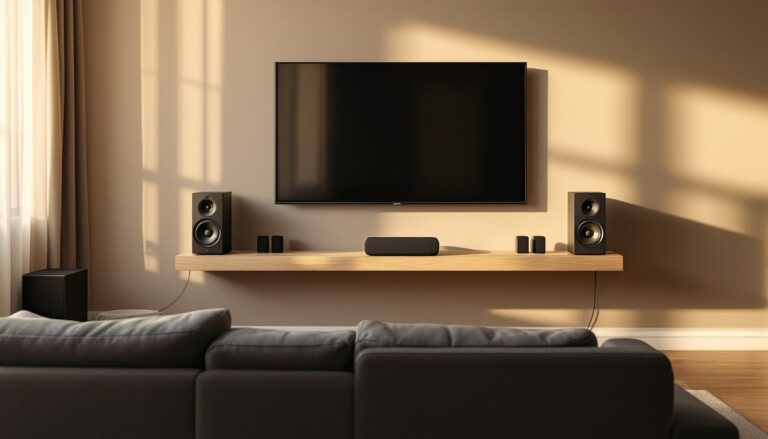
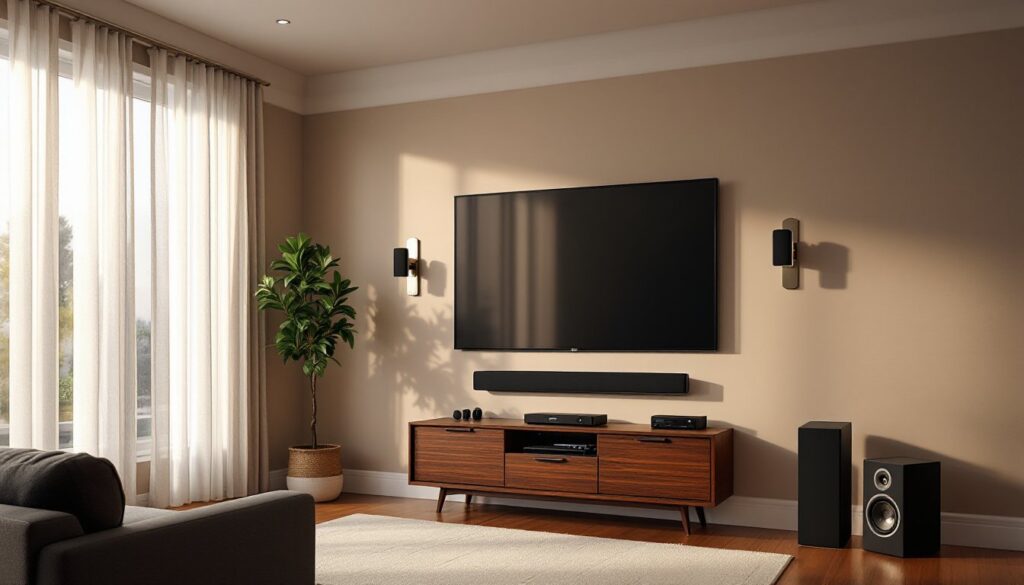
For spaces under 300 square feet, a soundbar setup avoids the clutter of multiple speakers while still delivering a marked improvement over TV audio. The Harman Kardon Citation MultiBeam 1100 is the current flagship soundbar, measuring 43.3 inches wide and packing 11 drivers with eARC support for lossless Dolby TrueHD passthrough. It handles 4K/120Hz video signals, which matters for gamers and newer streaming boxes.
The Citation soundbars use beam-forming technology, arrays of drivers firing at angles to bounce sound off walls and create a pseudo-surround effect. This works well in rectangular rooms with drywall, less so in spaces with heavy curtains or open floor plans. Adding the optional Citation Sub S (10-inch downward-firing woofer) fills in the low end for action movies without rattling picture frames, assuming proper placement away from corners.
Budget-conscious buyers might consider the Citation One MKIII as a single-speaker upgrade for bedrooms or offices, it won’t replicate surround sound, but it handles stereo music and streaming audio with more presence than typical compact speakers.
Complete Surround Sound Packages for Larger Spaces
Rooms over 300 square feet benefit from discrete speakers. The Harman Kardon HKTS 16 is a 5.1-channel package with four satellite speakers, a center channel, and a 200-watt powered subwoofer. Satellites use 3-inch mid-woofers and measure just 4.6 inches tall, making them easy to mount on walls or tuck onto shelves. The center channel is critically important, it handles 60-70% of a film’s dialogue, and this one uses dual 3-inch drivers in a horizontal configuration.
For whole-room coverage in spaces up to 500 square feet, pair the HKTS 16 with a Harman Kardon AVR (audio/video receiver). The older AVR 1515 offers 5 x 65 watts, HDMI 1.4 inputs (adequate for 1080p but limiting for 4K HDR), and zone 2 output for playing audio in a second room. Newer models like the AVR 2700 step up to HDMI 2.1, Dolby Atmos decoding, and 7 x 125 watts, though at a price jump.
Another option gaining traction: the Citation Tower speakers, which function as wireless floor-standing mains. They’re suited for music-first systems where movies are secondary, since they lack the dynamic range for explosive soundtracks but excel with vocals and acoustic instruments.
For dedicated home theaters in basements or bonus rooms, consider pausing before buying. If the space exceeds 500 square feet or has vaulted ceilings over 10 feet, a custom installer can calculate speaker coverage and recommend models with higher sensitivity ratings. Harman Kardon’s consumer lines aren’t designed for commercial-scale spaces.
Setting Up Your Harman Kardon Home Theater: DIY Installation Tips
Start with the AVR or soundbar placement. Receivers generate heat, plan for 3 inches of clearance on all sides for ventilation. Glass-door cabinets look clean but trap heat: add a small USB-powered fan if ventilation is tight. Soundbars sit directly below or above the TV: mounting brackets are included with most models, but confirm the bracket’s weight rating matches the soundbar (the MultiBeam 1100 weighs 11.2 pounds).
Speaker wire matters more than marketing suggests. For runs under 50 feet, 16-gauge copper wire is sufficient for 8-ohm speakers. Longer runs or 4-ohm speakers (check the manual) need 14-gauge to prevent power loss. Strip 1/2 inch of insulation, twist the strands tight, and ensure no stray copper touches both terminals, shorts damage amplifiers.
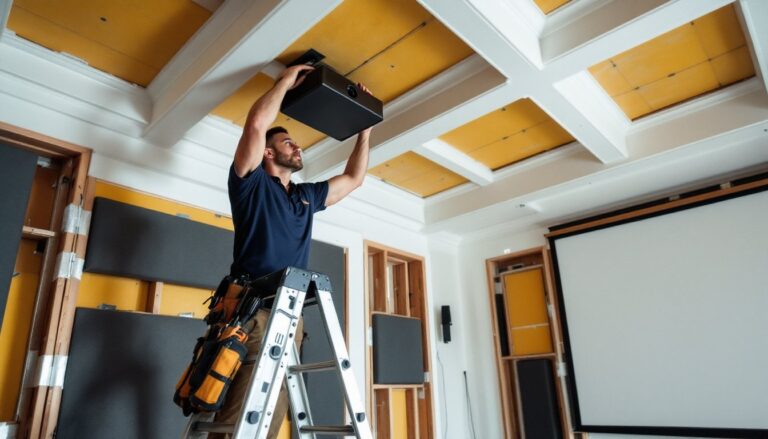
When mounting satellite speakers, use a stud finder to locate solid backing. Drywall anchors rated for 30 pounds work if studs aren’t positioned right, but toggle bolts are more secure. Run cables inside walls if possible (requires a drywall saw, fish tape, and patching compound afterward). For surface runs, use cable raceways or flat speaker wire that tucks under baseboards.
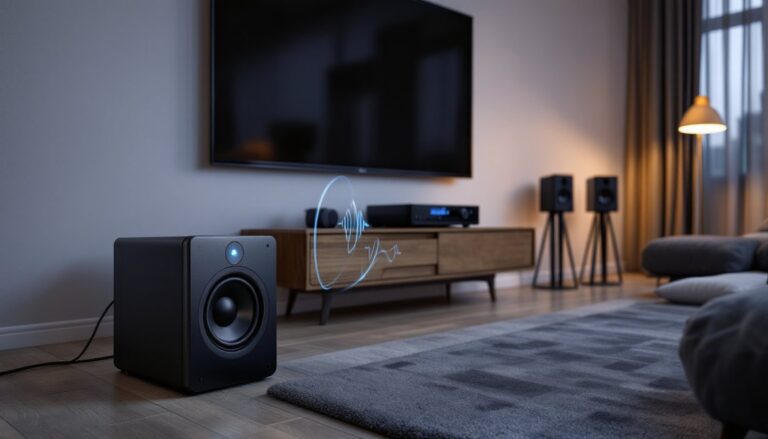
Subwoofer placement is trial and error. The “subwoofer crawl” technique works: place the sub in the main seating position, play a bass-heavy track, and crawl around the room’s perimeter. Where the bass sounds tightest and deepest, that’s where the sub should go. Corner placement boosts output but can cause room modes (boomy peaks at certain frequencies). Experiment before drilling mounting holes.
HDMI connections should follow this order: source devices (Blu-ray, streaming box, game console) connect to the AVR’s HDMI inputs, then a single HDMI cable runs from the AVR’s output to the TV’s eARC or ARC port (usually HDMI 1). This allows the TV’s apps to send audio back to the receiver. Enable CEC in both the TV and AVR menus for unified remote control.
Run the AVR’s auto-calibration with the included microphone. Place it at head height in the main seating spot, close windows to reduce noise, and let the system measure distances and levels. Results aren’t perfect, manual tweaking often helps, but it’s a solid starting point.
Safety note: wear safety glasses when drilling overhead for speaker mounts. If running cables through walls, shut off power to nearby outlets and use a voltage tester to confirm wires are dead before drilling.
Optimizing Your Room Layout and Speaker Placement
The center channel sits directly above or below the TV screen, angled toward the seating area. Tilting it up or down by 10-15 degrees improves dialogue clarity if the speaker is significantly higher or lower than ear level. If mounting above a fireplace (not ideal but common), angle it down and consider acoustic treatment to reduce reflections off the mantel.
Front left and right speakers should form an equilateral triangle with the main seating position. For a couch 10 feet from the TV, place mains 10 feet apart and angle them inward by 20-30 degrees. Toe-in focuses the soundstage but can make the sweet spot narrower, good for single viewers, less ideal for families spread across a sectional.
Surround speakers belong slightly behind and above seated ear height (2-3 feet higher). Mount them on side walls, not the back wall, for 5.1 systems. The goal is ambient sound, not directional localization. Aiming them at the seating area creates a spotlight effect: pointing them at the opposite wall diffuses the sound naturally.
Avoid reflective surfaces near speakers. Glass coffee tables, bare hardwood floors, and large windows cause phase cancellation and comb filtering. Area rugs, upholstered furniture, and curtains absorb stray reflections. If the room sounds echoey with normal conversation, it needs acoustic damping before a speaker upgrade will help.
For asymmetrical rooms or open concepts, A/V receiver calibration tools help but can’t overcome poor placement. If one side of the room opens into a kitchen, consider repositioning seating or adding a bookshelf to break up the open space.
Subwoofer phase matters when pairing with small satellites. If bass sounds thin even though good placement, flip the sub’s phase switch from 0° to 180°. This realigns the sub’s output with the mains, fixing cancellation issues. Use a bass-heavy test track (movie explosions or EDM) to compare settings.
Measure twice, drill once. Painter’s tape marks on walls prevent measuring errors, and a laser level (around $25) ensures speakers align horizontally, eyeballing rarely works.
Budgeting for Your Harman Kardon Home Theater Upgrade
As of mid-2026, a basic Harman Kardon soundbar setup (Citation MultiBeam 700 or similar) runs $500-$800, with the optional sub adding another $400-$500. A complete 5.1 HKTS speaker package typically costs $800-$1,200, and pairing it with an AVR like the 1515 or 2700 adds $600-$1,500 depending on features. Expect total entry-level systems to land around $1,500 and flagship setups to approach $3,000-$4,000 before installation accessories.
Regional pricing varies. Coastal urban markets and authorized dealers charge more than big-box retailers or online discounters, but authorized channels offer better warranty service. Refurbished units from Harman’s outlet or certified resellers can cut costs by 20-30%, check that warranty coverage transfers.
Accessory costs add up. Quality speaker wire runs $0.50-$1.50 per foot, wall mounts are $20-$60 per pair, and HDMI cables capable of 48 Gbps (needed for 4K/120Hz) cost $15-$40 for 6-foot lengths. Budget an extra $200-$400 for cables, mounts, and miscellaneous hardware like drywall anchors and cable raceways.
Labor isn’t always necessary, but in-wall wiring or complex multi-zone setups benefit from a licensed low-voltage electrician (often $75-$150/hour). If the project involves opening walls or running conduit through finished spaces, factor 4-6 hours of labor plus drywall patching and repainting.
Permits typically aren’t required for audio equipment installation, but check local codes if cutting into load-bearing walls or adding outlets. Running new circuits for dedicated 20-amp lines (helpful for high-power subwoofers or rack-mounted equipment) requires a licensed electrician and often a permit.
Financing options exist through some retailers, but avoid promotional interest rates that balloon after 12 months. If cash is tight, prioritize a quality AVR and front three speakers (left, center, right) first, add surrounds and a subwoofer later. The front stage handles the majority of audio information, and upgrading incrementally prevents buyer’s remorse from overspending on an all-at-once purchase.
Used Harman Kardon gear holds value but verify model numbers and firmware versions. Older AVRs lacking HDMI 2.0 or eARC support limit future-proofing. Buying the latest model isn’t always necessary, but ensuring compatibility with current 4K and HDR standards prevents a second upgrade within a few years.